Scholarly Articles on Baby Boomers and Family Values
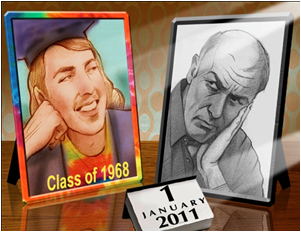 The iconic image of the Infant Boom generation is a 1960s-era snapshot of an exuberant, long-haired, rebellious young adult. That portrait wasn't entirely accurate fifty-fifty then, merely it's hopelessly out of date at present. This famously huge cohort of Americans finds itself in a funk equally it approaches quondam historic period.
On Jan 1, 2011, the oldest Babe Boomers will turn 65. Every solar day for the next nineteen years, almost 10,000 more will cross that threshold. By 2030, when all Baby Boomers will have turned 65, fully 18% of the nation'southward population will be at least that age, according to Pew Research Centre population projections. Today, merely xiii% of Americans are ages 65 and older.
Perched on the front stoop of old age, Baby Boomers are more downbeat than other age groups about the trajectory of their own lives and about the management of the nation equally a whole.
Some of this pessimism is related to life cycle – for most people, middle age is the most enervating and stressful fourth dimension of life.1 Some of the gloominess, however, appears to exist particular to Boomers, who bounded onto the national stage in the 1960s with high hopes for remaking society, simply who've spent most of their adulthood trailing other historic period cohorts in overall life satisfaction.
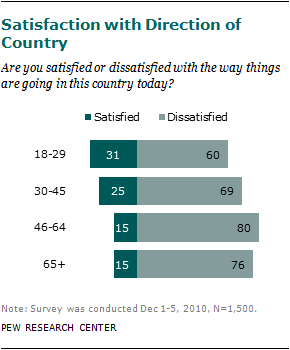
At the moment, the Infant Boomers are pretty glum. Fully eighty% say they are dissatisfied with the way things are going in the country today, compared with 60% of those ages 18 to 29 (Millennials); 69% of those ages xxx to 45 (Generation Xers) and 76% of those 65 and older (the Silent and Greatest Generations), according to a Pew Inquiry Center survey taken earlier this month.
 Boomers are also more downbeat than other adults about the long-term trajectory of their lives – and their children's. Some 21% say their own standard of living is lower than their parents' was at the age they are at present; amongst all not-Boomer adults, just fourteen% experience this mode, according to a May 2010 Pew Research survey. The same survey institute that 34% of Boomers believe their ain children will not savor every bit good a standard of living as they themselves have now; by contrast, just 21% of not-Boomers say the same.2
The 79 million member Baby Boomer generation accounts for 26% of the total U.Due south. population. Past force of numbers alone, they almost certainly will redefine one-time age in America, just as they've made their marking on teen civilization, young adult life and middle age.
Only don't tell Boomers that onetime age starts at 65. The typical Boomer believes that old historic period doesn't begin until historic period 72, according to a 2009 Pew Research survey. Almost half of all American adults say they feel younger than their actual age, merely fully 61% of Boomers say this. In fact, the typical Boomer feels nine years younger than his or her chronological age.3
On a range of social issues, Babe Boomers are more than accepting of changes in American culture and mores than are adults ages 65 and older, though by and large less tolerant than the immature. On matters related to personal finances, economic security and retirement expectations, they feel more damaged by the Slap-up Recession than do older adults.
Boomers are latecomers to the digital revolution, but are showtime to close their gadget and social media gap with younger generations. For example, amongst younger Boomers (ages 46-55), fully half now use social networks, compared with 20% in 2008. That rate of growth is more than rapid than for younger generations. Likewise, more than than half (55%) of older Boomers (ages 56-64) now watch online video, compared with 30% in 2008.
On the political front, Boomers—similar the nation as a whole – have washed some partisan switching in recent years. They narrowly favored Obama for president in 2008 (past 50%-49%), and then supported Republican congressional candidates past 53%-45% in the 2010 midterm elections, according to election mean solar day go out polls. In their cadre political attitudes about the role of government, they're more conservative than younger adults and more than liberal than older adults, co-ordinate to a comprehensive 2010 Pew Inquiry study on long term trends in political values past generation.
In 1970, when the oldest of the Baby Boomers were in their early on 20s, the total publicly held national debt was nigh $283 billion, or nigh 28% of the Gross Domestic Product. Now, as the oldest Boomers approach age 65, the federal debt is an estimated $ix trillion or 62% of Gdp – creating IOUs that members of younger generations may exist paying down for decades.4
However, a new Pew Research survey finds lilliputian appetite among Boomers for deficit reduction proposals that would take a bite out of their own pocketbooks. For example, 68% of Boomers (compared with 56% of all adults) oppose eliminating the tax deduction for interest paid on home mortgages; lxxx% (compared with 72% of all adults) oppose taxing employer-provided health insurance benefits; and 63% (compared with 58% of all adults) oppose raising the age for qualifying for total Social Security benefits.v
The Pew Research Heart has a deep annal of work that analyzes the demographics, economics, religious beliefs and practices and social and political values of the Babe Boomer generation, and makes comparisons with younger and older U.South. age groups. Our survey work includes questions about family life, personal finances, engineering science apply, aging and a range of other topics.
When asked about the assortment of changes transforming American family life, the Boomers' views marshal more than closely with younger generations than older ones. For example, Boomers, like younger adults, are far more than likely to say the master purpose of matrimony is common happiness and fulfillment rather than child-raising (seventy% of Baby Boomers and Millennial young adults say so, compared with 50% of adults ages 65 and older).
When asked whether children face "a lot more challenges" growing upwardly with divorced parents, racially mixed parents or unmarried parents, Baby Boomers and younger adults are less probable to say yes than are adults ages 65 and older.
However, despite the reputation they gained as young adults for favoring alternative lifestyles, Baby Boomers today are less accepting than younger Americans of same-sexual activity couples raising children, unmarried couples living together and other non-traditional arrangements—though they are more tolerant of them than are adults ages 65 and older.
When it comes to divorce, the Baby Boomers are less conservative than younger generations: 66% say divorce is preferable to staying in an unhappy spousal relationship, compared with 54% of younger adults who say so.
Despite differences by generations on these and other matters, a plurality 43% of Infant Boomers say there is less generational conflict now than in the 1960s and 1970s, when they were coming of age.
Personal Finances and Economic Views
Economically, Boomers are the well-nigh probable among all age groups to say they lost coin on investments since the Great Recession began. Baby Boomers also are the most likely (57%) to say their household finances have worsened. And a higher share of Boomers than older Americans (only non younger ones) say they have cut spending in the by year.
Amongst those Baby Boomers ages 50 to 61 who are approaching the terminate of their working years, six-in-10 say they may have to postpone retirement. Co-ordinate to employment statistics, the older workforce is growing more quickly than the younger workforce.
Engineering science and News
In their employ of technology, the youngest Baby Boomers (ages 45-55) are nearly as likely to be online (and to have a habitation broadband connection) as younger adults, and the oldest Boomers (ages 56-64) are notably more likely to be online than adults ages 65 and older.
Well-nigh ii-thirds of Boomers say they follow the news most or all of the fourth dimension, a higher share than among younger adults.
Organized religion
Past standard measures such as the share who pray daily or frequency of attending religious services, Babe Boomers are less religious than adults ages 65 and older just more religious than adults in younger generations.
Among Baby Boomers, 43% say they are a "strong" member of their religion, a higher share than amongst younger adults and a lower share than among older ones. Four-in-10 say they nourish religious services at least once a week. Conversely, 13% say they have no religious affiliation, less than younger adults but more than than older adults.
Baby Boomers: Explore Pew Research Surveys and Reports
Beneath are hyperlinks to Pew Inquiry Center publications from recent years that include information specifically nearly Baby Boomers. In some cases, they include data on adults ages fifty to 64, a range that includes well-nigh but non all Baby Boomers. In other cases, the research breaks the Baby Boomer generation into younger and older age groups.
Social Behaviors and Values
- The Decline of Marriage and Rising of New Families: Survey of attitudes on whether marriage is becoming obsolete; single mothers, same-sex couples and other non-traditional arrangements; importance of family; what's best for children.
- The Return of the Multi-Generational Family unit Household: Share living in multi-generational households.
- Forty Years After Woodstock, A Gentler Generation Gap: Views on generation gap, musical preferences, noesis almost Woodstock festival.
- Growing Onetime in America: Expectations vs. Reality: Views by age group on what constitutes old historic period and the signs of one-time age; practice yous feel younger or older than your real age; has life turned out meliorate or worse than expected; happiness.
- Every bit Wedlock and Parenthood Drift Apart, Public Is Concerned about Social Impact: Views about divorce, civil unions, premarital sexual practice, purpose and importance of marriage, children and marriage; profile of parents and divorced adults.
- Public Back up for Legalizing Medical Marijuana. Support for legalization of medical marijuana is equally high amid Boomers as younger adults, and college than among older adults.
Economy and Personal Finances
- How the Great Recession Has Changed Life in America: Bear upon of recession on electric current finances, financial behavior and employment; views on personal financial future and national economy'south time to come.
- Most Heart-Aged Adults are Rethinking Retirement Plans: Impact of recession on retirement plans of adults ages 50 to 64, which includes most Baby Boomers.
- Different Age Groups, Different Recessions: Recession-related changes in spending and beliefs, investment losses, investment confidence.
- Luxury or Necessity: How the generations differ on what is a luxury or necessity, including such possessions as cell phones and televisions.
- Inside the Middle Form: Views on personal finances, form, quality of life, comparisons with past and projection into hereafter, personal fiscal problems, priorities in life, task satisfaction.
Miscellaneous
- Millennials: Comparison of attitudes past generation on a broad variety of topics, including personal values, technology use, media consumption, everyday life activities, organized religion, social and political values. A related interactive graphic compares the demographics of today's Millennials (ages xviii-28) with Boomers and two older generations when they were the same ages the Millennials are now.
- Blacks Upbeat most Blackness Progress, Prospects: Views of black Americans (by age grouping) on satisfaction, racial progress and values. Views on intermarriage, race bigotry and trust in police by race/Hispanic groups and historic period.
- Who Moves? Who Stays Put? Where'south Home? E'er-moved or ever lived in hometown, years since last movement, plans to move, where is your truthful home, contact with home boondocks, why did you move to your electric current community or why do you stay in your habitation town.
- Men or Women: Who's the Better Leader? An exploration of public attitudes about gender and leadership; comparisons of ratings of genders on qualities such as honesty and hard piece of work; reasons for scarcity of top female leaders, views on discrimination, equal rights and which gender has the better life.
- Infant Boomers: The Gloomiest Generation: Views on quality of life, standard of living, getting ahead, optimism almost the futurity, including long-term trends and comparisons of older and younger boomers.
The authors give thanks our Pew Research Heart colleagues Daniel Dockterman, Carroll Doherty, Danielle Gewurz, Scott Keeter, Andrew Kohut, Lee Rainie and Wendy Wang for their assistance.
Scholarly Articles on Baby Boomers and Family Values
Source: https://www.pewresearch.org/social-trends/2010/12/20/baby-boomers-approach-65-glumly/
0 Response to "Scholarly Articles on Baby Boomers and Family Values"
Post a Comment