What Do You Call It When 1 Family Owns All the House on a Single Lane
Whittier, Alaska
The only way to attain Whittier in the dead of wintertime used to be past boat, when the conditions permitted, or by train, when the atmospheric condition permitted. That was until 15 years ago, when Alaska converted a World State of war II rail tunnel to handle cars, besides.
The drive through the single-lane tunnel can feel suffocating, but it's liberating for Whittier's residents, who suit their lives by the tunnel's timetable -- cars tin can only cross once an hour in either direction, and if y'all're trying to get dorsum to town afterward 10:30 p.one thousand., you're out of luck.
A common sight at the entrance to Whittier is of people who missed the concluding crossing sleeping in their cars. Many residents ain T-shirts that say "Pow." Prisoner of Whittier, that is.
The thing is, Whittierites never have to take the tunnel if they don't want to, even though the tiny southwest Alaska town is severed from the outside world in so many ways. It snows 22 feet a twelvemonth here, more than 1,000 times the normal national boilerplate (OK, Boston this past winter doesn't count).
About this serial
Corking American Stories is an occasional series on the unexpected places and unforgettable characters that help define the country.
Residents don't even have to go out the building they live in if they don't want to.
That's because Whittier, including its infirmary, schoolhouse and city government, functions inside one self-sufficient structure: a Cold War behemoth that seems amend suited to a urban center similar Newark (no offense to Jersey).
The xiv-story Begich Towers Incorporated, known around these parts simply equally BTI, is probably the last thing you'd expect to see in an outpost as remote as this.
It soars skyward, rudely interrupting the surrounding National Geographic landscape of glaciers and Prince William Audio. BTI withstands six months of rain every year, followed past vi months of snow and howling eighty mph winds. It was built to survive bombings, afterward all.
Inside, BTI feels like any massive condo complex in a big metropolis, except that when you stride outside in the winter, in that location are few places to go and no 1 to see.
Blitz-hr commute in Whittier ways a stop on every floor on the elevator. Information technology ways that even when it's freezing, metropolis employees like Jennifer Rogers tin can go to work in sandals that show off her red-lacquered nails. She doesn't even accept to have her three kids to schoolhouse; they have the elevator to the basement and run down a bunker-similar underground passage that connects BTI to the Whittier Community School.
Rumor has it that some folks have not stepped outside BTI for weeks, months and maybe even years.
Only about 220 people live in Whittier year-round, working in commercial angling, recreation and tourism or for the country ferry and railroad. Most of them have homes in the tower, as though they were occupying separate bedrooms in one huge firm. Virtually their isolation together, they say: "We're all family here."
One big family. With lots of love and, some say, equal parts dysfunction. Everyone takes care of each other, just everyone besides knows each other'south business organization.
Gorillas and guns
People came to this stretch of Alaska from far-flung places to start all over. They could pigsty up here and never be establish. But most arrived in hopes of making a better living.
Brenda Tolman, 64, was one of them. She was a sign painter in sunny California when she scooped up her twin boys and set up firm in Whittier.
"I was terrified when I first came out of that tunnel," she says of her big move in 1982. "I thought there would be a big gorilla standing here. The town looks like information technology should be in a horror picture show."
In fact, Hollywood was planning to shoot "Hunter-Killer" in Whittier this bound. It's a submarine thriller in which Whittier would stand up in for a Russian naval base. Ironic, since the metropolis was built-in as a U.South. military base after Pearl Harbor and played a key role in the early days of the Cold War.
The military congenital two monoliths -- BTI and the nearby Buckner Building -- but shuttered the base in the late 1950s after defense cuts and the invention of intercontinental ballistic missiles made it obsolete.
Several years later, Whittier incorporated equally a metropolis, and the tower, named to honor tardily Alaska Rep. Nick Begich, was deeded over in 1973.
The asbestos-laden Buckner Building met with a grimmer fate. No ane has ever coughed up the millions it would take to detoxify and renovate, and these days it sits inescapable from view like an ugly brute tamed by the elements.
Whittier residents don't heed the eyesore. It's a part of their history, they say.
"We're used to looking at it. Doesn't bother united states of america," Tolman says. "In fact, very petty bothers usa."
All this makes life peculiar here, and so much and then that a book about Whittier published 15 years agone was titled, "The Strangest Town in Alaska."
Whittierites know well that the circumstances of their lives are shaped by Mother Nature and physical boundaries. The defined space has, inevitably, defined the town's people, although ultimately, the concerns hither are no dissimilar than in the residuum of America: community, employment, education, health.
Information technology'south merely that everything nigh people and life gets wildly magnified here. And it can all go a bit weird.
A rebel and her reindeer
Sometimes, when the tundra winds stack the snowfall high, information technology'south impossible to open the forepart doors at Begich Towers. Only Tolman still goes out twice a day to a pen beyond the street where she keeps 2 reindeer.
One fourth dimension, the snowfall banks rose taller than the 15-foot fence and her pets meandered off, sending Tolman chasing after them. She thinks i reason people like living in BTI is because they never have to worry virtually shoveling snowfall. The city does it for them.
"It's all taken intendance of. And that's a big bargain around here."
Tolman's known as the matriarch of the building -- non just because she's been here then long, just because she likes to go along everyone in line. She tells it like it is. A bit of a rebel, she supposes.
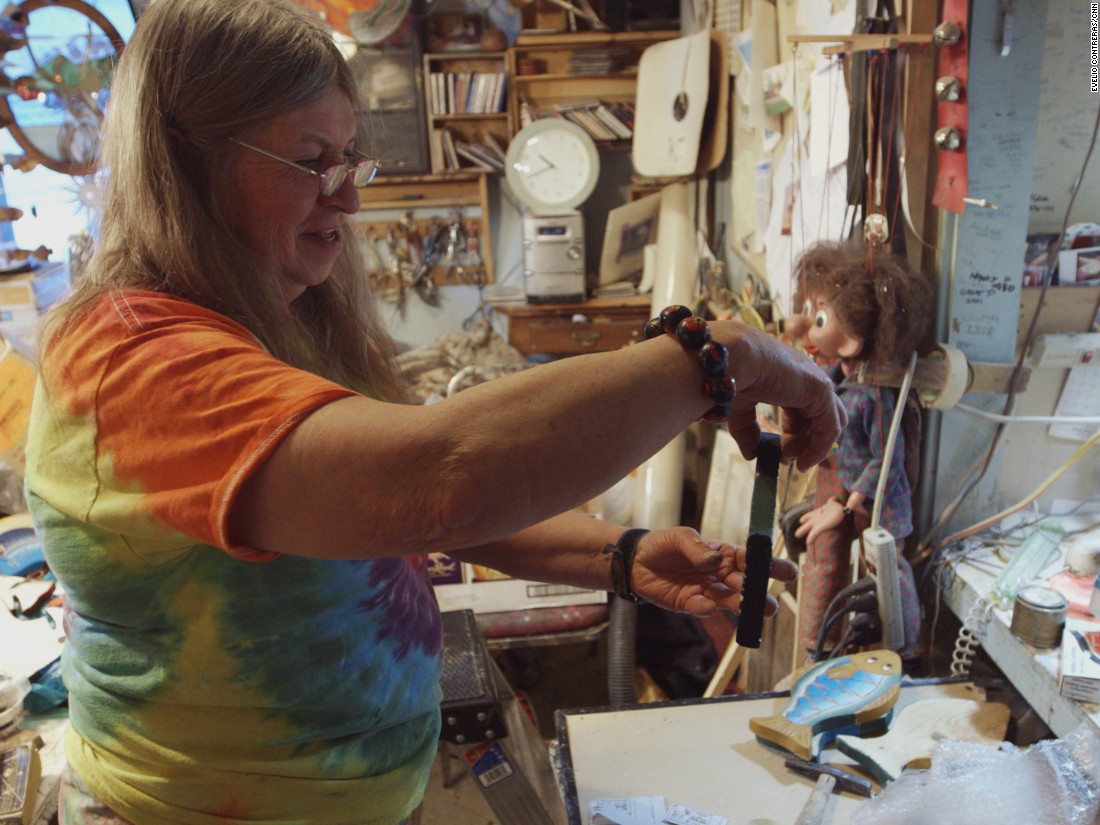
Brenda Tolman is 1 of the few residents who live outside the belfry, though she notwithstanding keeps her studio at that place.
Tolman walks down a narrow, cinder block and linoleum hallway and jokes most how BTI tin can feel like a mental establishment. She keeps to her artist's studio in the mornings because that's where she likewise hangs her shingle as Whittier's notary public. She gets busy painting carved wooden halibuts and takes a heavy drag of her Tareyton Menthol before explaining how she moved to Alaska for the fresh air and the chore opportunities.
Back and then, oil barons occupied Begich Towers and Tolman made a pretty penny lettering their fancy boats.
Merely when the toll of oil plummeted in the belatedly 1980s, Whittier'due south makeup changed and a whole new crowd of people moved in. More recently, waves of people from American Samoa, Guam, the Philippines and Hawaii have settled here.
Tolman used to alive on the seventh floor just couldn't stand up what she calls BTI's "forced socialization." Just because y'all can walk the halls in your pj's doesn't hateful you can visit people at any hour, she says. But that's what happens.
She needed privacy and wanted to make herself get exterior more, so she eventually moved to a small apartment circuitous downwards the road. It'south the only other place to live in Whittier.
Maybe, she surmises, that's the reason the mayor besides chose not to live in the tower.
"At BTI, anyone can prowl over in their socks and give him their stance," she says. "But if yous've got to get dressed and go out and get in the car and so drive over, well, possibly that's a little as well much."
Blurred lines
At lunchtime, students run out the doors of the Whittier school and down the subterranean walkway that spills out into BTI's cavernous basement. They walk past a maze of storage cages and a room full of freezers that rent for $15 a month. They're packed with steaks and other meats as well equally ice cream, loaves of bread, frozen dinners and anything else that volition keep. That's how people survive on days when it seems they may never feel the sun's warmth again.
A hush falls over the small school subsequently the students are gone.
Erika Thompson takes out her lunch from the refrigerator. It'south a homemade salad packed neatly in a plastic container inside a pinkish insulated tiffin bag. A mini container holds a vinaigrette dressing.
Thompson, 38, could just as easily go dwelling house to her 9th floor condo. She chooses not to.
"I like to create a separation from piece of work and dwelling house."
Often, she says, the boundaries become as well blurred.
Thompson uses the rest of her lunch break to run a few errands. She'southward leaving for a vacation in United mexican states the adjacent day.
"How-do-you-do, Ms. T," says one of her students as Thompson gets into the lift.
In Whittier, there's no getting away from her students. "I take the garbage out, I encounter my students. I do my laundry, I see my students," she says.
During the holidays, a student knocked on the door of her condo. When she opened it, he said: "I just wanted to make sure you were in the Christmas spirit. Brand sure you bring it to school."
Before that, at Thanksgiving, she needed to bake sweet potatoes in her oven. And so she held her reading form in her living room.
"Here the student-teacher human relationship is very different," she says, "because yous live among your students."
Thompson pops over to Kozy Korner, a minor convenience store on the first floor operated by Frankie and Ron Graham. She wants to make certain her apartment is stocked with teenager food.
"I'1000 buying junk food for my dog sitter," she announces as she picks up packages of instant ramen noodles and frozen burritos -- and a Fresca for herself. She thinks about a pocketbook of chips.
"Wow. $9. At present you lot know why I go to Anchorage."
Kozy Korner's stock depends on what the Grahams pick up on their shopping trips to Anchorage, some lx miles north. Besides pasta, love apple sauce and cans of Dinty Moore stews, there's 1 can of Pledge furniture smooth, a box of Special G cereal, two bottles of Cutex nail smooth remover, i gallon of black walnut water ice cream and five cartons of tempura batter.
Frankie Graham says the store adds greatly to the building's self-sufficiency. She recalls a fourth dimension afterward an avalanche when food and supplies had to be airlifted to other towns. Just not here.
"The only thing we needed here was infant food."
Thompson pays a hefty sum for her junk food and returns to schoolhouse. She shows off an indoor hydroponic garden she started so the kids would appreciate fruits and vegetables more. The school acquired the equipment after the law busted a guy who was using it to abound pot in his BTI condo.
Next to the garden is an indoor playground; Thompson, a sometime fitness jitney, is big on physical activity.
Many of the BTI kids hang out in the building's vestibule during tiffin, fifty-fifty though that'southward against the rules. It'southward a big bone of contention in the building: how much freedom to give to the kids, specially in the wintertime when everyone is trapped inside. Some of the older folks would like BTI to function more as an adult facility, maybe even a retirement home.
Only others believe that if the children become away, so will the free energy in the building.
The kids vanish from the lobby when they hear a building staffer walking their way.
"It'southward amazing how they all besprinkle when they see me," the staffer says, straightening upwardly chairs and picking up candy wrappers. "They know they're not supposed to get together here. They don't have care of information technology."
'God'southward petty acre'
Tolman says in that location really is no other place on Earth she'd rather live.
Whittier is beautiful and safe. "God's little acre," she calls it.
In recent months, she'south taken a fancy to the Samoan community at BTI and started attending their church service, 1 of two held every Sunday in the basement, near the storage cages.
Tolman goes not necessarily to get God, but to listen to the music. It lifts her up and puts joy in her centre, like a flare-up of summer in the middle of winter's bleakness.
Without diversion, Whittier has the potential to drown a person in claustrophobia. "You gotta be proficient with being past yourself," Tolman says. "Or it tin become lonely."
That'due south perhaps the irony of living here, in an out-of-place tower of a city on the west bank of Prince William Sound. You lot take to learn to live with others at close quarters, but ultimately you've got to honey yourself.
What Do You Call It When 1 Family Owns All the House on a Single Lane
Source: https://www.cnn.com/interactive/2015/07/us/whittier-alaska-american-story/
0 Response to "What Do You Call It When 1 Family Owns All the House on a Single Lane"
Post a Comment