Binomial Distribution of a Family With 5 Children
A Binomial random variable can exist defined by two possible outcomes such equally "success" and a "failure". For example, consider rolling a fair six-sided die and recording the value of the face. The binomial distribution formula can be put into utilize to calculate the probability of success for binomial distributions. Often it states "plugin" the numbers to the formula and calculates the requisite values.
The binomial distribution is based upon the following characteristics:
- The experiment contains n identical trials.
- Each trial results in 1 of the two outcomes either success or failure.
- The probability of success, denoted p, remains the same from trial to trial.
- All the n trials are independent.
Recognize the Binomial Variable
In lodge to recognize the binomial variable, the following weather are applicable:-
- Fixed number of trials.
- Every trial is independent of i another.
- Each trail has ii possibilities.
- Success
- Failure
- Probability for success is divers by (p) and probability for failure is defined by (i-q).
For Example, consider the post-obit instance
A off-white money is flipped xx times; X represents the number of heads.
X is binomial with n = xx and p = 0.5.
If the above 4 conditions are satisfied then the random variable (north)=number of successes(p) in trials is a binomial random variable with
- The Mean (Expected Value) is: μ = Σxp
- The Variance is: Var(10) = Σxtwop − μtwo
- The Standard Deviation is: σ = √Var(X)
X Percentage Rule of Bold Independence
The 10% status of assuming independence defines that sample sizes should be no more than 10% of the population.
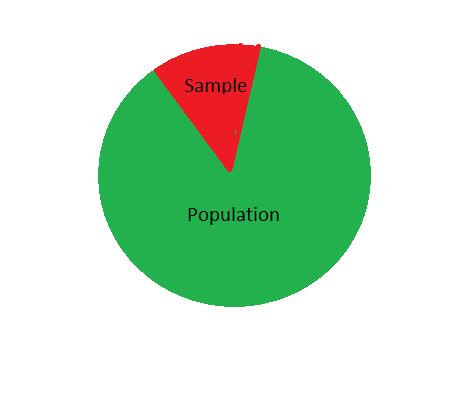
The 10% Rule of Assuming Independence condition normally applies to the following cases:-
- While drawing samples without replacement. For Example, In the Central Limit Theorem.
- When proportions from 2 groups are there
- Solving differences of ways for very small-scale populations or an extremely large sample.
- While dealing with Bernoulli trials.
Note: Usually,10% of weather condition mentioned won't notice statistical means. For means, the samples are commonly smaller, making the condition necessary simply if sampling from a very small-scale population.
The status applies in Bernoulli trials, where the vast majority of cases y'all sample without replacement.
Binomial Distribution
A binomial distribution is defined as the probability of a SUCCESS or FAILURE event in an experiment that is repeated multiple times. For example, in a coin toss experiment heads or tails and taking a examination could have 2 possible outcomes- Pass or Neglect.
In the binomial formula, the number of times the experiment runs is denoted by n
The probability of one specific outcome is denoted by p.
For Example, In an experiment to know the probability of getting a five on a die gyre. If you were to roll a die 10 times, the probability of rolling a one on any throw is 1/6. Whorl x times and you lot have a binomial distribution of (n = 10, p = one/6).
SUCCESS = if the roll is five on a die.
FAILURE = if the roll on die is other than 5.
The binomial distribution formula is:
b(10; n, P) = nCx * Px * (1 – P)north – x
where:
- b = defined as a binomial probability
- x = It is the total number of "successes" (laissez passer or neglect, heads or tails, etc.)
- P = The probability of success on an individual trial
- due north = Defines the number of trials
Note: The higher up mentioned Binomial Formula tin can also be written every bit :
nCx = north! / x!(northward – 10)!
Visualization of a Binomial Distribution
Consider a trial of north Independent binomial distribution. SUCCESS in 'n' independent is trials is defined by probability 'p' in binomial distribution with parameters north and p.
For Instance, in an experiment of tossing a off-white money. The number of heads in 20 tosses of a coin has a binomial distribution with parameters
north = twenty and p = 50%.
The expected value of the binomial distribution is divers every bit follows:
northward × p
The standard error of the binomial distribution is defined as
(north × p × (1 – p))½
If the following iv conditions are met then the random variable is binomial:
- Fixed number of trials = n
- Each trial has two possible outcomes:
- success
- failure.
- The probability of success is stated = p
- All the trials should be contained which means that one trail output should non depend on others.
Binomial Distribution Example
In an experiment of tossing a fair coin 10 times, then the probability of getting exactly 6 heads can exist calculated as:
b(x; northward, P) – northCx * Px * (1 – P)n – x
Example:
The number of trials (due north) = 10
Success ("tossing ahead") = 0.5
q= 1 – p = 0.five, x = 6
Solution:
P(ten = 6) = 10Csix * 0.5^vi * 0.v^4
= 210 * 0.015625 * 0.0625
P(10 = 6) = 0.205078125
Generalizing grand scores in northward attempts
Binomial Probability Formula :

then solving the above results into,

It can also simply written equally,
P(X = r) = Combinations × P(yep) × P(no)
The combinations, here's the formula:
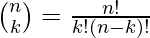
Derivation of Binomial Distribution
The outcomes of the binomial distributions are commonly depicted as SUCCESS and FAILURE. The usual notations which are used to denote such notations are
- p = probability of success,
- q = probability of failure = 1 – p
Therefore, p + q = 1.
In a Bernoulli trial, each repetition of an experiment involves but 2 outcomes.
- Independent – In this, the result of one trial does not affect the result of another trial.
- Repeated – In this, atmospheric condition remain the aforementioned in each trial. Information technology states that p and q remain constant across trials.
In a binomial distribution,
The probabilities of involvement are those of receiving a certain number of successes = r,
In n independent trials each having simply two possible outcomes and the aforementioned probability, p, of success.
- Following divers is the number of different means which shows Northward singled-out things may be arranged in society is
Northward! = (one)(2)(three)...(N-1)(North), (where 0! = ane)
- Below mentioned are the number of means of selecting r distinct combinations of Northward objects, irrespective of a valid lodge, is represented as
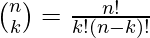
Let's apply the formula binom{n-1}{k-one} to this expression and simplify the effect is shown below:

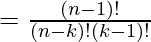
Furthermore,

Following the properties of the factorial function equally shown below:

Use the to a higher place formula to derive the property of the binomial coefficient,

at present using the commutative belongings of multiplication (ten . y = y . x), the correct-mitt side can be rewritten every bit,

Now, using the above equations we tin equate,


Now, the concluding identity can exist ended as,

Free Throw Binomial Distribution
Consider a scenario to detect the all-time free-throw shooter on your loftier school basketball squad. To find a season gratis throw pct, Free Throw Binomial Distribution is put into use
For this, consider an example of Graphing Binomial Distribution:
Consider variable p that will represent the free throw percentage of your best free throw shooter. If the accuracy of the shooting throw is 90%
Then p = 0.9, p represents the probability of a "success"
To find the probability the athlete will make 3 out of 10 shots if his costless throw percent is 90%.
- Using the binomial formula:
b(x; due north, P) – nCx * Px * (1 – P)n – x
- Using the computer: binompdf (ten, 0.90, 3).
Example:

similarly, by calculating values from P(Ten = 2) to P(10 = 10) following values are obtained :
Solution:
| X | 0 | 1 | ii | iii | iv | 5 | 6 | 7 | 8 | 9 | 10 |
| P(X) | .006 | .04 | .121 | .215 | .251 | .201 | .111 | .042 | .011 | .002 | .000 |
Considering the in a higher place values following graph is obtained:
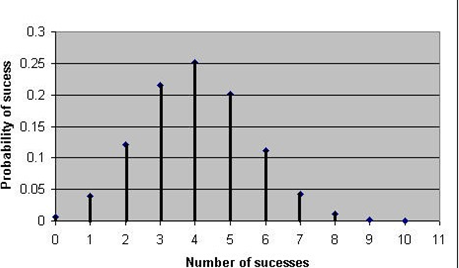
Binomial distribution n=x, p=2
Binompdf and binomcdf Functions
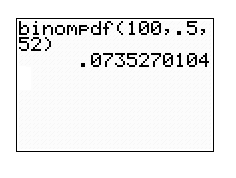
The binompdf part on TI 83 or 84 calculators is used for finding the probability of exactly some number of successes.
P(X = c) = binompdf(n, p, c)
where,
n = number of trails
p = number of success
c = probability of exactly c success, for number c.
Case: A off-white coin is tossed 100 times. What is the binompdf probability that heads will appear exactly 52 times?
Solution: Using the Binomial formula
= binompdf (number of trials, probability of occurrence, number of specific events)
= binompdf (n, p, r)
The binomcdf function on the TI-84 calculator. It can be used to solve bug where probability is less than or equal to a number of successes out of a sure number of trials.
Example: To calculate the probability of less than or equal to 45 successes out of 100 trials, the post-obit method is used;
P(X = c) = binomcdf(due north, p, c)
where,
n = the number of trials
p = the probability of success for any particular trial
c = number of successes.
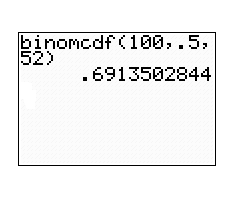
Example 4: A fair money is tossed 100 times. What is the probability binomcdf there will be at most 52 heads?
Solution:
binomcdf (number of trials, probability of occurrence, number of specific events)
= binomcdf (north, p, r)
Example: In a burger store seventy% of people preferred to eat a non-veg burger while others prefer to swallow something else. What is the probability of selling 2 non-veg burgers to the adjacent 3 customers?
Solution:
The probabilities for "not-veg burger" all piece of work out to exist 0.147 because
0.147 = 0.7 × 0.7 × 0.three
Or, using exponents:= 0.72 × 0.31
The 0.7 is the probability of each choice we want, call information technology p
The two is the number of choices we want, call it grand= pk × 0.31
The 0.iii is the probability of the opposite choice, so it is: 1−p
Using formula = pk(1 – p)(north – k)
Where p is the probability of each choice we want
k is the number of choices we want
n is the total number of choices
p = 0.seven (chance of non-veg burger)
m = two (non-veg burger choices)
n = three (total choices)
Then we become: pk(one-p)(n-k) = 0.72(1-0.7)(3-2)
= 0.72(0.3)(1)
= 0.vii × 0.7 × 0.3
= 0.147
Three other possibilities are : (not-veg, non-veg, other) or (non-veg, other, non-veg) or (other, non-veg, not-veg)
n!g! / (due north-1000)! = three!two!(3-2)!
= three×2×12×one × one
= 3
iii (Number of outcomes nosotros desire ) × 0.147 (Probability of each outcome ) = 0.441
So, seventy% choose non-veg burger, so seven of the next x customers should choose non-veg burger
p = 0.7
north = 10
k = 7
And we go: pk(one-p)(n-k) = 0.77(1-0.vii)(x-7)
= 0.77(0.3)(3)
= 0.0022235661
And the total number of those outcomes is:
n!thousand!/(n-grand)! =10!7!/(10-7)!
= 10×nine×8×7×6×5×4×3×two×17×6×5×4×3×2×1 × 3×ii×1
= ten×nine×83×2×1
=120
120 (Number of outcomes nosotros want) × 0.0022235661(Probability of each consequence ) = 0.266827932
So the probability of seven out of 10 choosing a non-veg burger is only about 27%
Binomial Distribution of a Family With 5 Children
Source: https://www.geeksforgeeks.org/binomial-random-variables-and-binomial-distribution-probability-class-12-maths/
0 Response to "Binomial Distribution of a Family With 5 Children"
Post a Comment